
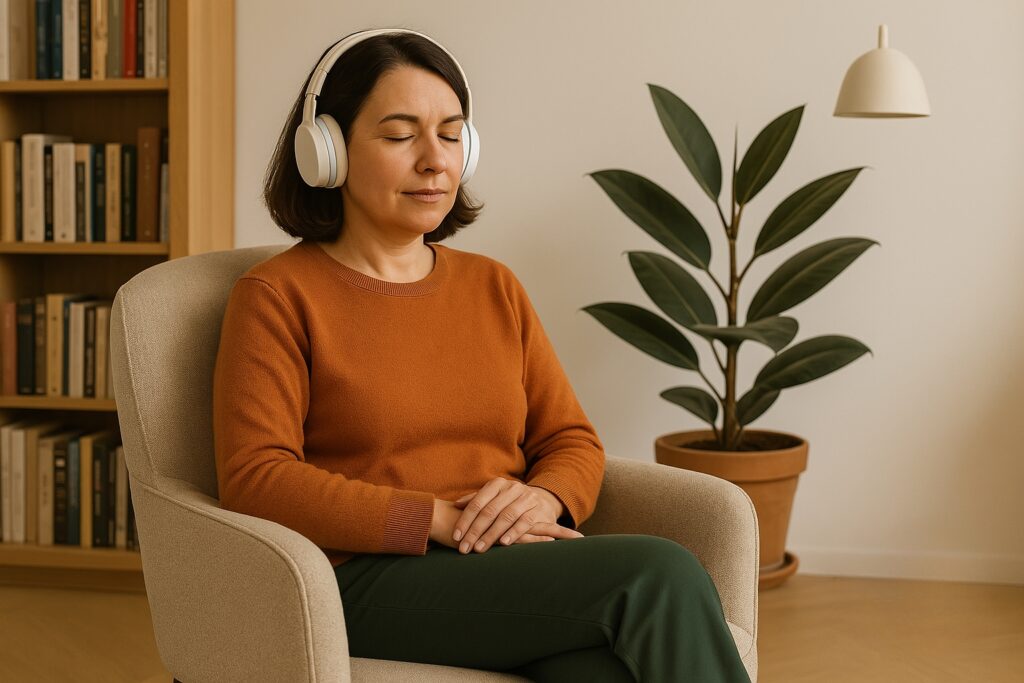
If you’re familiar with Alfred Tomatis, pioneer of sound therapy with Audio-Psycho-Phonology (APP), you may already have explored his methods.
Holopsonie, an approach derived from his work, has been relaunched with contemporary adjustments and modernized tools.
In this article, find out more about this exciting development… and why you might want to try it out with our short, no-obligation rental formula.

Alfred Tomatis and the beginnings of sound therapy
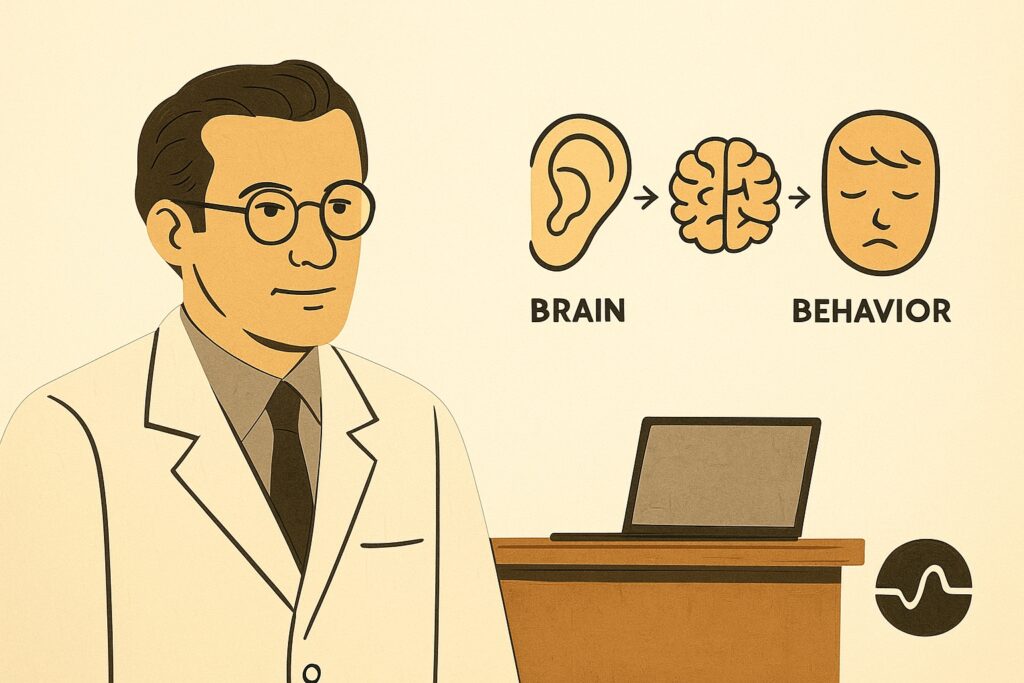
Alfred Tomatis (1920-2001), a French ENT doctor, was a pioneer in the study of the influence of sound on the brain and behavior. He developed APP (Audio-Psycho-Phonology), a method using filtered music according to standardized protocols.
Its aim is to promote the overall development of the individual, by acting on cognitive, emotional, psychomotor and relational dimensions. In particular, the Tomatis Method aims to improve attention, memory, language, coordination, posture and even voice, by working on brain plasticity through listening. It has been used in contexts as varied as school learning, neurodevelopmental disorders, psychosomatic pathologies and support for artists and therapists.
The Tomatis reference protocol is based on three listening cycles, each consisting of two sessions per day for 10 days, spaced several weeks apart. This standard protocol represents around 60 hours of listening, and requires rigorous professional guidance.
Tomatis’s research has influenced many modern approaches, including Holopsonie.
Guy Berard’s influence and the foundations of Holopsonie
Holopsonie was born in Amiens in 1985, thanks to Dominique Bourdin and Jean Bouchet. Both were inspired by the work of Tomatis, but above all by that of Guy Berard (1916-2014), one of his students. In the 90s, Berard developed AIT (Auditory Integration Training). While practicing as a general practitioner, Dominique Bourdin was able to observe the remarkable beneficial effect of this method on a patient, while the local gazette “Le Courrier Picard” had reported with reference to the local manufacture of the equipment used: ” The machine to heal depression is manufactured in Amiens”
“.
Bérard identified hypersensitivity to frequencies between 1500 and 8000 Hz in certain people suffering from depression or autism. He showed that auditory rebalancing could reduce or even eliminate certain symptoms. His approach gained notoriety in the United States with the publication of the book Sound of a Miracle, in which Annabel Stehli recounts the spectacular improvement of her autistic daughter thanks to AIT.
Jean Bouchet, who collaborated successively with Tomatis, Bérard and Bourdin, played a central role in the integration of these approaches within Holopsonie.
The beginnings in Amiens and the end of the project
Between 1985 and the early 2000s, Bourdin and Bouchet developed and manufactured the first Holopsones devices. Their aim: to use sound to reharmonize body and mind. Production was discontinued almost 15 years ago, however, leaving the approach dormant… until today.
The rebirth of Holopsonie by Holotech Industry
In 2023, Pierre Griffoin relaunched Holopsonie by founding Holotech Industry in Lyon. Building on the legacy of Tomatis, Bérard, Bourdin and Bouchet, he modernized the approach and equipment.
Major developments include:
- The music is personalized according to individual auditory perceptions, thanks to a listening test.
- Sessions are short: 1 or 2 a day for 5 to 10 days.
- The devices can be used independently at home.
- The method is available for short-term rental, for a no-obligation trial.
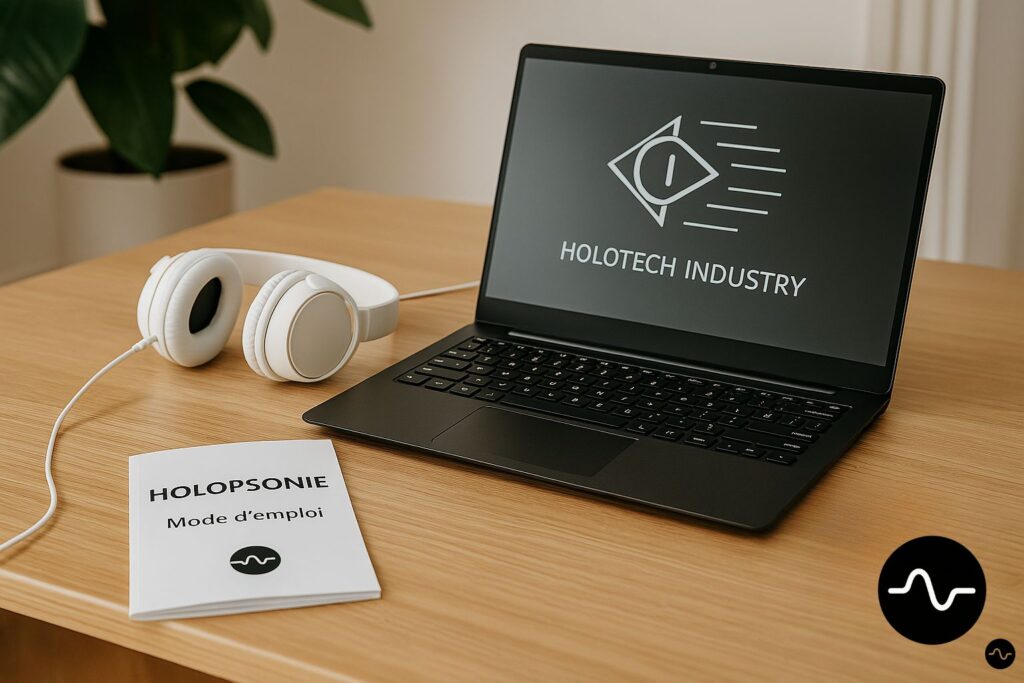
What sets modern Holopsonia apart
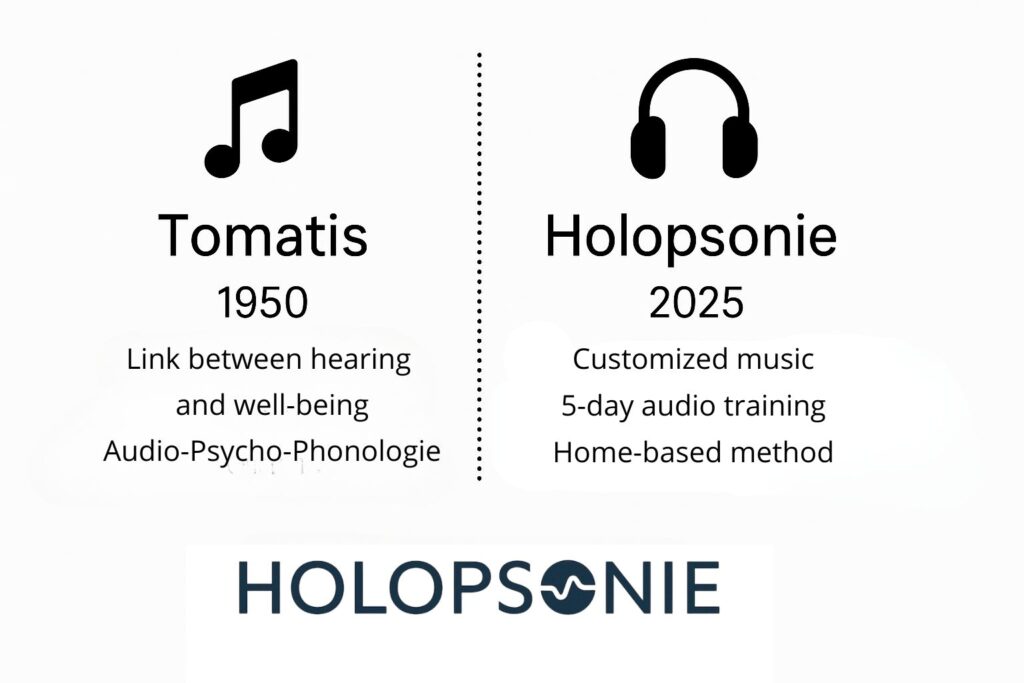
In contrast to conventional approaches based on generic music and long processing times, Holotech Industry’s Holopsonie is characterized by a :
- Personalized: each protocol is fine-tuned to your individual hearing profile, based on a listening test.
- Accessible: users can enjoy the experience at home, at their own pace and independently, using an audiophile player and appropriate headphones.
- Concise: 6 to 10 sessions spread over 3 to 10 days are generally enough to feel the first effects.
But Holopsonie’s originality lies not only in the flexibility of its protocol. It also relies on a finesse of analysis and sound processing that is far more precise than in previous approaches:
- Each ear is tested and treated independently, taking into account their natural asymmetry.
- Auditory sensitivity is measured frequency by frequency, on 15 to 25 points divided into twelfths of an octave, offering a much finer reading than the quarter or third octaves generally used.
- Sound treatment is customized to mirror the listening experience, attenuating areas of hypersensitivity and stimulating areas of hyposensitivity.
- Sound modulation causes a bass/treble switch, prompting the brain to “reconstitute” the original signal, stimulating auditory and emotional plasticity.
These technological and therapeutic choices enable a more targeted, faster and often deeper impact on cognitive, sensory and emotional levels.
Why try Holotech Industry’s Holopsones?
The new Holopsones combine scientific rigor with ease of use. Many users report significant benefits, such as :
- Reduced stress,
- Improved concentration,
- Overall well-being.
Our short rental formula lets you try out the method at a lower cost. It’s a great way to find out more without hurrying.

An enriched, accessible approach to sound
Holopsonie is a continuation of the research carried out by Tomatis and Bérard, enriched by Bourdin and Bouchet, and relaunched today by Holotech Industry. More accessible, more personalized, it adapts to your pace of life.
Want to find out more? Click here to contact us.